THE THINKING BEHIND THE WORK
Creative solutions rarely begin with having all the answers. They begin with understanding the destination, recognizing the conditions around us, and being willing to adjust the course when necessary.
A lifetime spent in emergency medicine, aviation, healthcare leadership, writing, and now software development has reinforced one lesson again and again: the most direct-looking path is not always the path that gets us where we need to go.
Sometimes progress requires a small correction. Sometimes it requires looking at the problem from an entirely different direction.
The destination can remain the same even when the course changes.
CREATIVE SOLUTIONS AT COMPASS ROSE WORKS
Creative Solutions is about applying real-world experience to problems that may not have obvious answers.
It means looking beyond the way something has always been done, identifying what is actually preventing progress, and finding a practical path forward.
The lessons may come from a cockpit, an ambulance, a hospital, a management office, a manuscript, or a computer screen. The setting changes. The principle does not:
Understand the problem. Know the destination. Then find the course that gets you there.
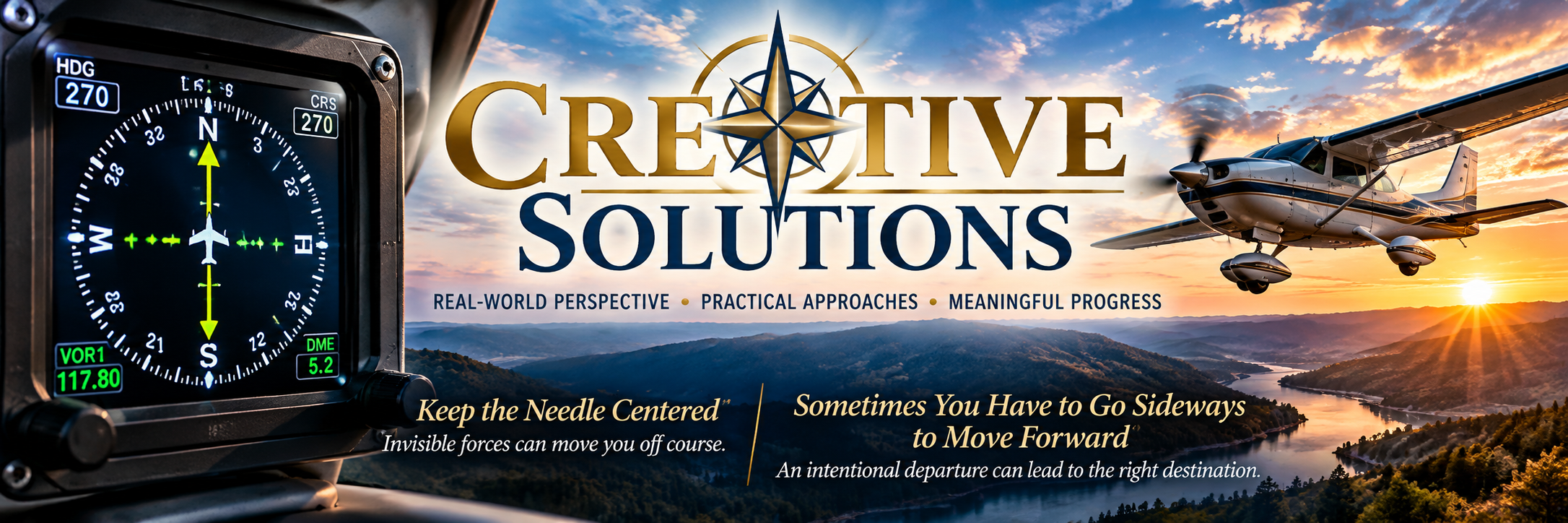
KEEP THE NEEDLE CENTERED
A lesson from the cockpit about the forces we cannot see.
THE AVIATION LESSON
A pilot can point an airplane toward the correct destination and still end up miles away from it.
The reason is wind.
You cannot see the wind. You may not immediately recognize what it is doing to the airplane. A crosswind can continually push the aircraft away from its intended course even while the compass shows that the airplane is pointed in what appears to be the right direction.
The Course Deviation Indicator—and, in more advanced form, the Horizontal Situation Indicator—shows the pilot something the compass alone cannot:
Not simply where the airplane is pointed, but whether it is actually staying on the intended course.
By watching that indication and making small corrections for wind drift, the pilot can remain on course instead of discovering miles later that the airplane has wandered far from it.
THE CREATIVE LESSON
Business and creative work have their own invisible winds.
Changing markets, unexpected costs, customer response, technology, timing, assumptions, and even our own habits can gradually push a project away from where we intended it to go.
Simply working harder in the same direction does not necessarily correct the drift.
The answer is feedback. Look at what is actually happening. Compare it with the destination. Then make the correction while it is still small.
A course correction does not mean the original destination was wrong. In fact, sometimes changing the heading is exactly what keeps you on course.
Set the destination. Watch the needle. Correct for the wind.
SOMETIMES YOU HAVE TO GO SIDEWAYS TO MOVE FORWARD
A lesson from the cockpit about why the most direct path isn't always the best one.
THE AVIATION LESSON
On final approach, a pilot may sometimes find the airplane higher than desired or carrying more energy than is appropriate for landing.
Simply pointing the nose toward the runway and forcing the airplane down is not necessarily the best solution.
One technique available to the pilot is a slip. By deliberately crossing the flight controls, the airplane presents more of its side to the relative airflow. That increases drag and allows the aircraft to lose altitude more rapidly without simply accelerating toward the runway.
To someone watching from the ground, the airplane may appear to be flying partly sideways.
It is.
But that sideways movement has a purpose. The pilot has not abandoned the runway or changed the destination. The maneuver is being used to put the airplane in a better position to arrive where intended under the right conditions.
Sometimes going sideways for a while is exactly what gets you where you need to go.
THE CREATIVE LESSON
Progress does not always look like forward motion.
Sometimes a project carries too much complexity. A plan moves faster than the circumstances will support. An idea needs refinement before it can safely reach its destination. At other times, an obstacle makes the obvious path ineffective.
The instinct may be to push harder and keep moving straight ahead.
But sometimes the better solution is an intentional move sideways—to simplify, test an idea, develop another skill, solve a different problem first, or temporarily redirect resources.
From the outside, that can look like a detour. It may even feel like one.
But if the maneuver improves your position while preserving the destination, you haven't lost your way. You're positioning yourself to arrive successfully.
Forward progress isn't always measured in a straight line.
CLOSING THOUGHT
Seek, Plan, Persist
WHEN THE OBVIOUS PATH ISN’T WORKING, LOOK AT THE PROBLEM DIFFERENTLY.
At Compass Rose Works, Creative Solutions brings real-world experience, practical thinking, and a willingness to challenge assumptions to problems that need a different approach.
Whether the challenge involves a creative project, a business process, an idea that has stalled, or simply finding a better way forward, the objective remains the same:
Understand where you are. Know where you want to go. Find the course that connects the two.